
As the demand season approaches, it’s tempting to assume the calls will take care of themselves.
Phones ring, dispatchers fill boards, and technicians stay busy. It sounds like the system is working
— but is it really?
The truth is, most HVAC companies will never receive enough inbound repair calls to completely fill
a technician’s schedule every single day. Not even during much of the peak season. And the
companies that accept that reality — and do something about it — are the ones that consistently hit
their revenue goals.
The ones that wait? They leave a staggering amount of money on the table, week after week,
month after month.
The Standard: At Least 4 to 5 Billable Homes Per
Technician, Per Day
At EverRest, we’re clear about the minimum standard: Every technician should be in a minimum of
4 to 5 billable calls per day (that can be a combination or repair calls and tuneups). Not as a stretch
goal — as the baseline.
Most days, hitting that number will require more than just waiting for repair calls. It means
proactively filling your schedule with billable calls, such as:
• Tune-up and maintenance appointments
• Follow-up visits from previous calls
• Proactive outreach to existing customers
• Scheduled membership and service agreement calls
Don't overlook tune-up bookings just because you’re entering the busy season. In fact, this is
exactly when tune-up appointments matter most. They keep your schedule full on the days when
inbound calls dip, and they put your technicians in front of customers who may need repairs,
system upgrades, or replacements they don't yet know about.
— You’ll never hit your goals by waiting for calls to come to you. —
The Numbers Don’t Lie: A 3-Technician Company, One Week
Let’s put some real numbers behind this. Consider a company with 3 technicians. We’ll look at 2
scenarios across a standard 5-day work week, using a $700 AVERAGE REPLACEMENT
CONVERSION RATE per call — Here’s how the Replacement Conversion Rate is calculated…
REPL. CONV.RATE = $REPL SALES FROM TECHS IN HOMES / # BILLABLE CALLS RUN (calls
can be either repairs or tune-ups).
$70,000 Replacement Sales / 100 billable calls run = $700 Replacement Conversion Rate
Scenario A: Technicians in 5 homes per day, inbound calls + outbound calls for tune-ups, at an
average of $700 replacement sales per call (that’s a $700 Replacement Conversion Rate).
Scenario B: Technicians in only 3 homes per day, no outbound calling for tune-ups, at $700
average replacement sales per call.

IN JUST 1 WEEK, Scenario A generates $52,500, compared to $31,500 in Scenario B — a difference of $21,000.
Now Imagine a Full Month — or a Full Year
One week of underperformance is recoverable. But when the pattern repeats week after week — fewer homes visited, compounding daily — the gap becomes a chasm.
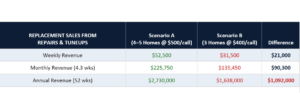
That’s $1,092,000 per year in lost revenue from a single company with just 3 technicians — caused by 2 fewer homes entered per day. Just a consistent commitment to keeping technicians in homes increased replacement sales from $1,638,000 to $2,730,000.
— The schedule doesn’t fill itself. Your competition isn’t waiting. Neither should you. —
Monitor Your Schedule Every Single Day
Keeping technicians in homes requires active schedule management — not a set-it-and-forget-it approach. Your dispatchers and service managers need to review the board daily with one question in mind: Are all of our technicians in a minimum of 4 to 5 homes tomorrow?
If the answer is no, the work begins immediately:
• Identify open slots and book tune-up or maintenance appointments
• Call customers who are due for seasonal service
• Follow up on estimates or repairs that were deferred
• Reach out to members who haven’t had a visit this season
The goal is not to be reactive. The goal is to own your schedule before the day begins, not scramble to fill it after it falls short.
The Bottom Line: Stay in Homes All Season Long
The message is simple, but it takes discipline: focus on keeping your technicians in homes, even during the busy season.
Repair calls are great. But they’re unpredictable. Your schedule cannot depend on them alone. Billable calls – from tune-ups, maintenance appointments, and proactive outreach – are what bridge the gap between a good week and a great week.
The companies that build this habit — that monitor their boards daily, hold the standard of at least 4 to 5 homes per technician, and fill every gap with intention — are the companies that grow. The ones that wait for the phone to ring are the ones that wonder at the end of the year where all the revenue went.